
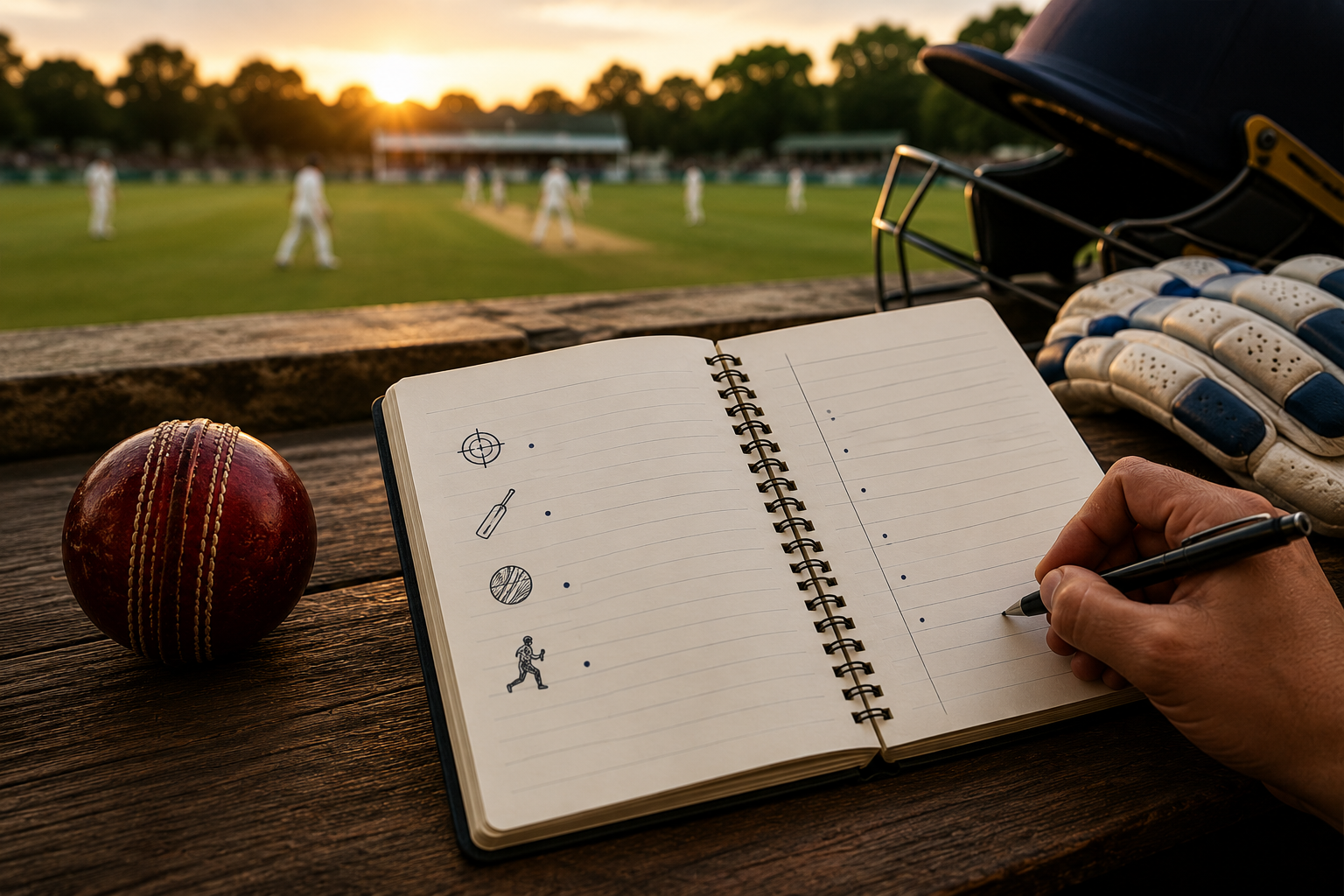
A cricket diary should not just be a place where you write, “Got out for 12. Annoying.”
That might be honest, but it does not help much.
Used properly, a cricket diary helps you understand your game. It connects training, preparation, match performance, mindset and next steps.
That is where the value is.
The point is not to write pages. The point is to capture the information that helps you improve.
Start before the match
A good diary entry starts before the game.
Write down your match focus.
Not five things. One or two.
For a batter:
- Watch the ball hard early
- Leave well outside off
- Look to rotate strike
For a bowler:
- Hit the top of off
- Stay strong through the crease
- Reset after a bad ball
For a fielder:
- Attack the ball
- Communicate early
- Stay switched on every delivery
This gives you something to come back to when the game gets noisy.
And cricket does get noisy. Pressure, teammates, opposition, conditions, mistakes and emotions all compete for attention.
A clear focus helps.
After the match, go beyond the scorecard
The scorecard tells you what happened. It does not always tell you why.
A batter can make 8 and actually bat well. A bowler can take 2 wickets and still bowl without control. A fielder can have no catches but save runs and create pressure.
So after the game, ask better questions.
For batting:
- How did I start?
- What balls caused me trouble?
- Did I make good decisions?
- How did I get out?
- What would I train from that innings?
For bowling:
- What was my plan?
- Did I hit my length?
- How did I respond under pressure?
- What worked against different batters?
- Did my body and rhythm feel right?
For fielding:
- Was I switched on?
- Did I move early?
- Did I communicate?
- Did I attack the ball?
- What moment should I learn from?
This turns a match into useful feedback.
Be honest, not brutal
There is no value in writing a diary entry that just attacks yourself.
“I was useless” is not a review.
Try to be accurate instead.
“I rushed early and chased a wide one” is useful. “I lost my length after being hit for four” is useful. “I stopped wanting the ball after the dropped catch” is useful.
Those are things you can train.
Look for patterns
One diary entry is useful. Ten diary entries are much more powerful.
Over time, you might notice:
- You start innings better when you have a clear plan
- You lose focus after a mistake
- You bowl better when you warm up properly
- Your fielding energy drops when you are not involved early
- You keep repeating the same dismissal
That is gold.
Because once you see the pattern, you can train the pattern.
Finish with one next focus
Every diary entry should end with one action.
Not ten. One.
Examples:
- Next training: practise leaving outside off
- Next match: reset properly after a boundary
- Next session: work on catching while moving forward
- Next week: prepare earlier before bowling
That is how reflection becomes progress.
Switch Hit is designed to make this easier: record the match, capture the reflection, and turn it into the next training focus.
A cricket diary is not about living in the past.
It is about playing better next time.